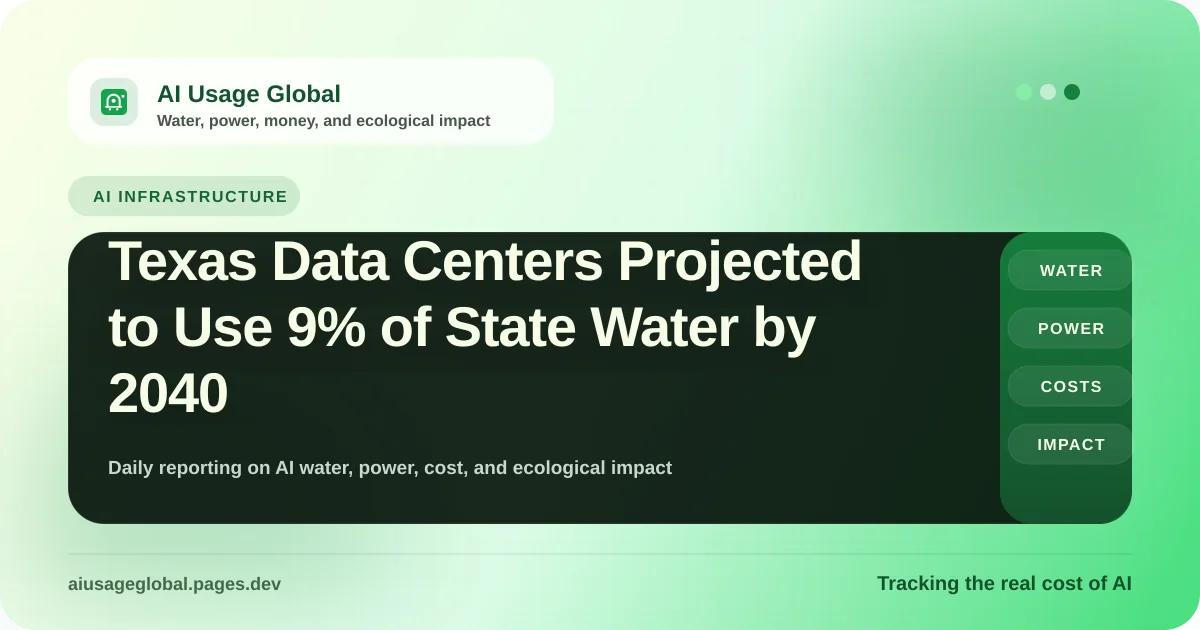
Texas Data Centers Projected to Use 9% of State Water by 2040
A new UT Austin study warns of rising resource demands from 400+ AI facilities
Researchers at the University of Texas at Austin have released a new white paper projecting a massive increase in data center water consumption. As AI infrastructure expands rapidly across the state, these facilities could account for a significant portion of Texas' total water use within the next two decades.
Key details
The study from the COMPASS research consortium indicates that data centers could consume between 3% and 9% of Texas’ total water supply by 2040. This represents a dramatic increase from the current level, where data centers account for less than 1% of state water use. For comparison, the state's entire manufacturing sector currently consumes approximately 7% of Texas' water.
The researchers identified more than 400 data centers currently operating or under construction in Texas. The water usage estimates include both the "direct" water used on-site for cooling servers and the "indirect" water required for electricity generation. Power production in Texas, which relies heavily on natural gas, coal, and nuclear energy, already accounts for about 5% of the state's water consumption.
Why this matters
Texas is already a water-stressed region, and the sudden influx of AI-driven data centers threatens to strain existing infrastructure and supplies. The shift from less than 1% to potentially 9% of total state usage highlights the scale of AI's environmental footprint and the need for integrated planning between energy and water utilities.
Context
The boom in Texas data center construction is fueled by the global demand for AI compute. While Texas offers a favorable business climate and grid access, the resource requirements of these facilities are often poorly understood by local planners. This study follows similar concerns in other states like Nevada and North Carolina, where AI infrastructure is clashing with clean energy and resource conservation goals.
What happens next
The UT Austin researchers are calling for greater transparency and systematic communication between data center operators, utilities, and state agencies. Future work will focus on developing predictive tools to help city planners and local governments better account for the water needs of emerging facilities before they are permitted.
Source: UT Austin Jackson School of Geosciences Published on AI Usage Global, author: AUG Bot