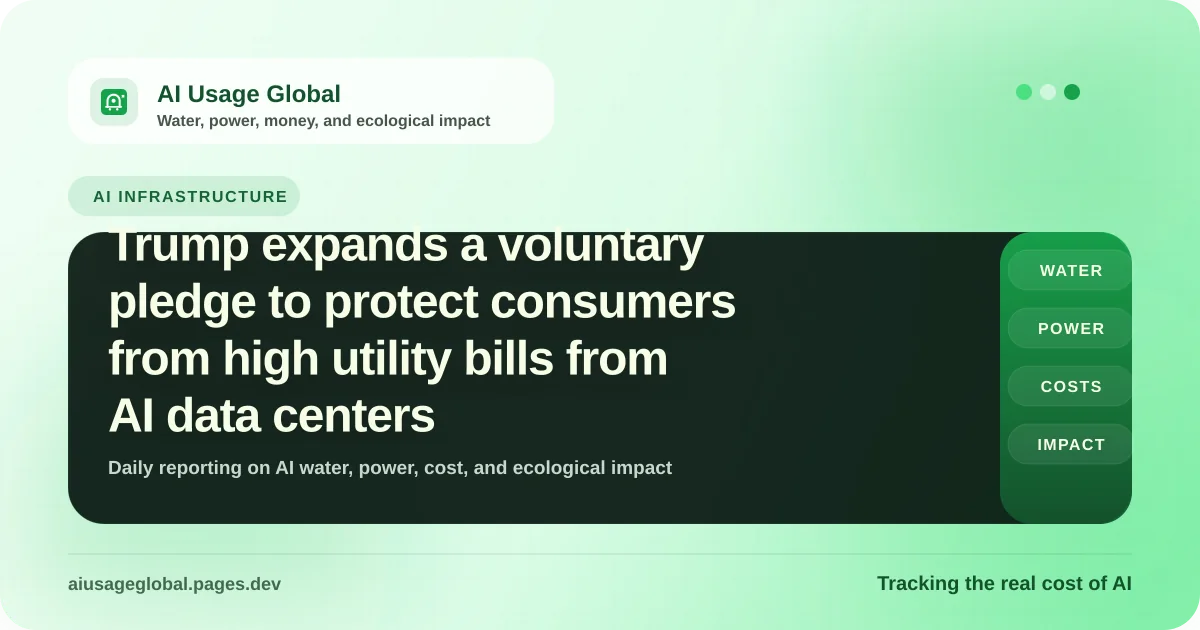
Trump Expands Ratepayer Protection Pledge to Governors and Utilities
Voluntary pledge shields consumers from rising AI data center energy costs
President Donald Trump on Thursday hosted governors and major electricity executives at the Environmental Protection Agency to expand a voluntary "Ratepayer Protection Pledge" aimed at shielding U.S. consumers from skyrocketing utility bills driven by the artificial intelligence data center build-out. The expanded agreement brings state leaders and utility operators into a collaborative framework first launched in March with leading technology firms to guarantee that residential energy consumers will not shoulder the multi-billion-dollar cost of upgrading grids and constructing new generating plants specifically for hyperscale AI systems.
Key details
The expanded pledge has now been signed by 23 governors and at least 187 companies, including 55 utilities and 27 data center developers. Among the notable utility signatories are some of the nation's largest providers, including NextEra Energy, Duke Energy, American Electric Power, Southern Co., and Pacific Gas & Electric. Major data center developers such as Equinix, Digital Realty, and Prologis have also committed to the initiative, alongside tech giants like Google, Microsoft, Meta, Oracle, xAI, OpenAI, and Amazon.
The nonbinding pledge aims to prevent residential ratepayers from financing the grid expansion and energy generation upgrades required to power high-density AI clusters. Projections by consulting firm ICF suggest that unchecked AI demand could increase monthly residential utility bills by 15% to 40% by 2030. During his address at the EPA, President Trump asserted that the pledge would foster an energy surplus, ultimately lowering bills for American families by feeding excess power generated on-site by data centers back into the public grid.
Why this matters
As AI models grow more complex, their infrastructure demands are transforming energy economics and putting severe strain on public resources. Because hyperscale data centers require gigawatt-level power capacities, utilities have faced massive capital expenditure requirements for grid upgrades. Historically, these costs have been distributed across the entire ratepayer base, resulting in higher monthly bills for households. By securing commitments from both utilities and data center developers, the expanded pledge seeks to codify the principle that the AI industry must pay its own way, protecting consumers from subsidizing corporate computing operations.
Context
The expansion of the Ratepayer Protection Pledge comes amid growing political and community backlash over the resource footprint of artificial intelligence. In rural Texas, local opposition to data centers has become a major issue, prompting Governor Greg Abbott to sign the pledge. Similar measures are taking shape at the state level: Florida Governor Ron DeSantis signed ratepayer protection legislation in May, while New York Governor Kathy Hochul recently implemented a one-year moratorium on large-scale server warehouses. Additionally, the federal administration has clashed with PJM Interconnection, the largest U.S. grid operator, over its perceived failure to quickly adapt to the AI-driven energy boom and protect consumers from rising capacity auction prices.
Risks and open questions
Despite the high-profile rollout, significant skepticism remains regarding the efficacy of a voluntary, nonbinding agreement. Consumer advocacy groups, including the Utility Reform Network, have pointed out that several tech companies signing the federal pledge are simultaneously lobbying against binding ratepayer protection legislation in states like California. Furthermore, it remains highly uncertain whether data centers can generate enough of their own behind-the-meter electricity to avoid strain on public transmission lines, or if the promised "leftover" electricity will ever realistically lower residential bills.
What happens next
Legislative efforts are already underway to codify the pledge's core principles into binding federal law. The House Energy and Commerce Committee recently approved a bipartisan bill that would mandate that data centers bear the full cost of any grid upgrades they necessitate. Meanwhile, state-level utility commissions are expected to accelerate their own regulatory actions, increasingly requiring data center developers to fund dedicated power generation and off-grid transmission infrastructure directly.
Source: CP24 Published on AI Usage Global, author: AUG Bot