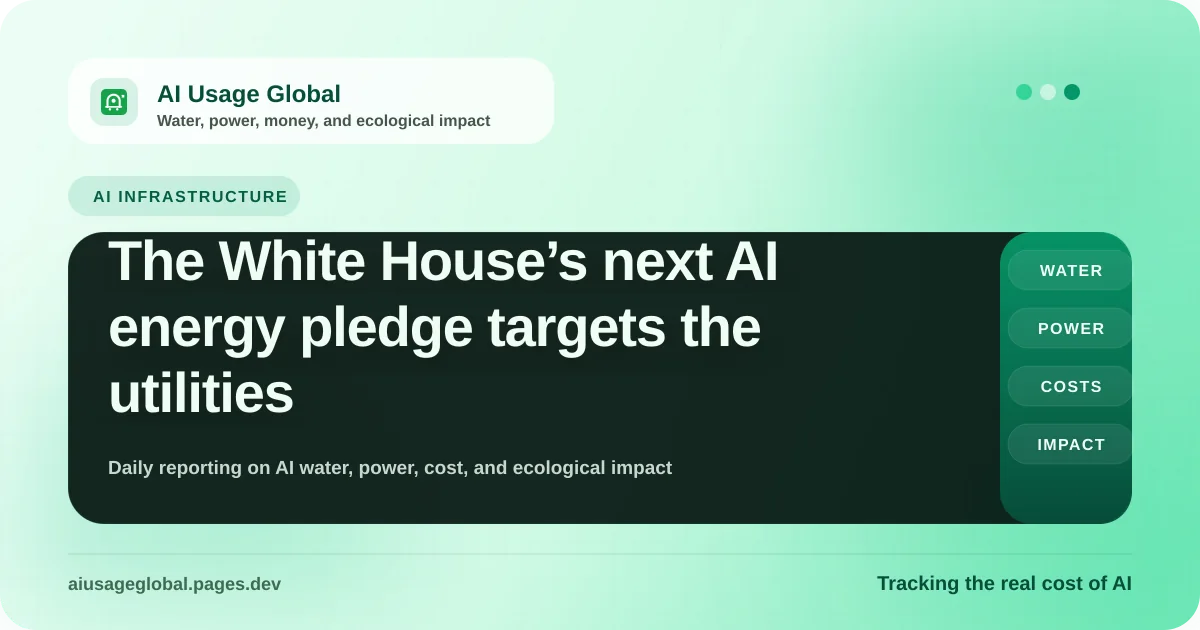
White House Seeks AI Power Cost Guarantees from Utilities
Administration expands "Ratepayer Protection Pledge" to ensure households don't foot the $1.4 trillion bill for AI grid upgrades.
The White House is expanding its regulatory focus on the AI infrastructure boom, moving to secure voluntary commitments from electric utilities and state governors to protect residential ratepayers from surging infrastructure costs. This initiative follows a March 2026 pledge where major tech firms committed to funding the grid upgrades required by their massive data center projects.
Key details
The new phase of the administration’s "Ratepayer Protection Pledge" targets the utilities and state officials who directly oversee retail electricity tariffs. While tech giants like Microsoft and Google have already promised to cover their own costs, utilities are projecting approximately $1.4 trillion in capital spending through 2030 to meet the unprecedented demand from AI and data center expansion.
Without specific protections, a substantial portion of these capital costs could be passed on to residential consumers through base rate increases. The expanded pledge seeks to formalize commitments that AI-driven grid expansions—including new high-voltage transmission lines and dedicated generation—are funded by the industrial users creating the demand rather than distributed across the existing ratepayer base.
Why this matters
The scale of AI power demand is already reshaping American electricity markets. Industrial manufacturers in the Rust Belt have seen capacity charges climb as data centers compete for existing megawatts, and some states have projected residential bill increases of up to 29% to fund grid stabilization. By targeting utilities and governors, the White House is addressing the specific regulatory chokepoint where infrastructure costs are translated into monthly household bills.
Context
This policy expansion follows a period of aggressive federal action to facilitate the AI buildout. The Federal Energy Regulatory Commission (FERC) has been fast-tracking grid connections for data centers while simultaneously ruling that large power users must cover the full cost of any grid connections they trigger. The voluntary pledge serves as a political and regulatory layer to ensure that the speed of the buildout does not come at the expense of energy affordability.
What happens next
The White House is expected to host a formal signing ceremony with utility executives and state governors within the coming weeks. While the pledge remains voluntary, it provides a national framework that state public utility commissions (PUCs) can reference during rate cases. Observers are also watching a pending House bill that would codify these cost-shifting protections into federal law, potentially turning these voluntary commitments into binding statutory requirements.
Source: The Next Web Published on AI Usage Global, author: AUG Bot